At the Lesbian Herstory Archives, Labor of Love Keeps History Alive
Oct. 20 2025 (Academic Project)
The perfect Sunday weather did not keep Caro Caden, 25, from staying indoors - specifically, at The Lesbian Herstory Archives (LHA) townhouse in Park Slope.
“I love being at the Archives,” they enthusiastically said.
Caden is one of the many coordinators - or, as they put it, “volunteers with a little bit more involvement and responsibility” - who have dedicated their time to protecting and promoting lesbian history by doing their part to keep the Lesbian Herstory Archives thriving.
Accompanied by their friend, Roddy Kunal, 31, Caden opened the doors to a townhouse that felt vibrant, alive, and welcoming. The mudroom was filled with posters and pamphlets. The library held bookshelves that reached up to the ceiling. The walls displayed photographs of those the Archives sought to remember.
In the “largest lesbian archives in the world,” one could see that lesbian history was in every room, every corner, and every wall.
The Lesbian Herstory Archives, Caden explained, was born out of “a group of lesbians that were involved with the Gay Academic Union,” but felt “overshadowed by the gay men in the group.”
“They realized quickly that lesbian history was disappearing as soon as it was being made,” said Caden.
The LHA’s first location was Joan Nestle's apartment on the Upper West Side in 1974. Nestle, 85, was one of the founders and now lives in Australia, but is still “very much involved” with the Archives. Deborah Edel, 81, another co-founder, lives in New Jersey and is “constantly in the building,” a “very involved” figure as well.
Kunal - whose friendship with Caden began at LHA - became involved with the archives after hearing “about it from plenty of queer people in [her] circle.” Her first visit to the Archives was for a tour - also known as LHA Open Hours. “I thought it was really well organized. I met a lot of really cool people,” said Kunal who has also attended other LHA events, such as speed -dating meetups.
In the Special Collections Room, the “collections are organized chronologically,” and they dated back to 1979, “basically when they were donated to [LHA],” explained Caden. The Archives “first special collection was Adrienne Rich’s.” And, the Archives also holds “over twenty boxes of [Audre Lorde’s] papers,”
As the doorbell rang, Caden suddenly said, “I'm gonna go for a second.” It turned out that a journalist, who had scheduled research hours, had just arrived. The brief interaction between them and the journalist was another example of the importance of Caden’s work - to make the archives available to anyone and everyone.
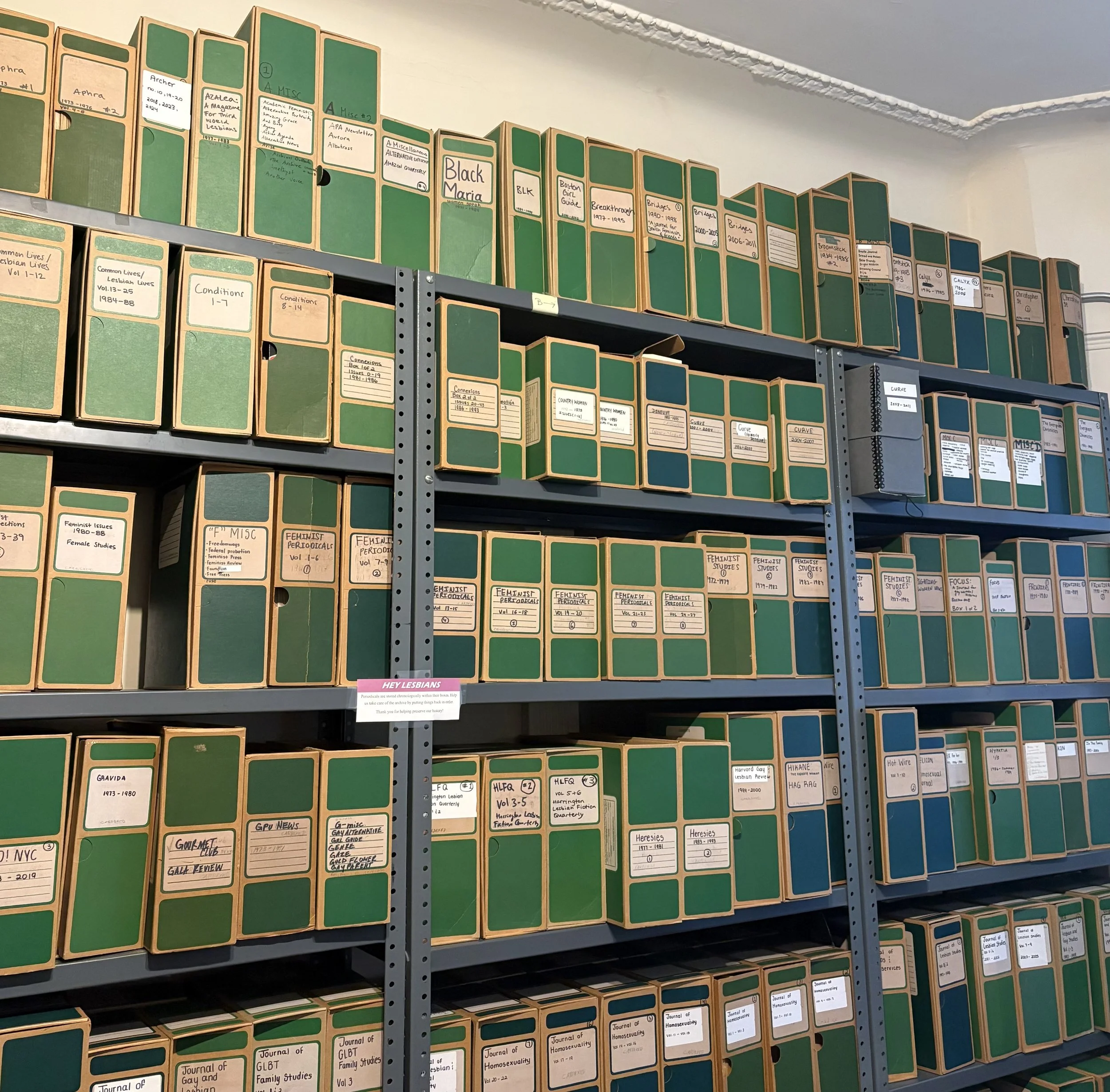
Surrounded by collections dating back to the early 1940s in the periodicals room, Caden explained that the Archives have never accepted government funding. At the LHA, “no one gets paid to work” - everyone is a volunteer.
In other words, for over fifty years and counting, the Lesbian Herstory Archives have been kept alive by people like Caden, who dedicate their time, week after week, to ensuring that lesbian history has a home and a future in this country - and, by extension, in the world.
In the Yellow Wallpaper Room, guests can find biographical files organized “by first name because [the Archives] is anti-patriarchal,” Caden pointed out. They also explained that the LHA separates biographical archives by first name “because a lot of lesbians would only go by their first name, for anonymity’s sake - especially in the 1950s.”
In the International Collections Room, one can find materials from all over the world - “Ireland, England, Australia, Japan, New Zealand” - and everything in the room is organized by “where the publication was published out of,” explained Caden. The International Collection is yet another example of how people have relied on the Archives to preserve and share the history of queer communities in their countries.
“Do you happen to have anything from India?” Kunal, whose family is from India, asked her friend while browsing the International Collection. A few moments later, Caden exclaimed, “Oh—Indian and Indonesia! Yes, pull it out, pull it out!” As they both browsed the Indian collection, it became clear that preserving lesbian history was not only a matter of honoring the past, but also of enlightening the present.
“Yay, Roddy, I'm so happy,” exclaimed Caden.
“The thing about, like, queer people in India is that they have their own history […] and a lot of it has been suppressed by colonialism,” said Kunal.
“I'm trying not to be, like, emotional right now,” She added, in a very emotional way.